
Burnout Iceberg & The Invisible Forces Driving Staff Burnout in Schools with Sue Langley
What’s really driving staff burnout in schools?
Burnout in schools is often framed as a personal issue. We are encouraged to strengthen our boundaries, build resilience, and manage our time more effectively. And while those things matter deeply, they are not the whole story.
In this episode, Meg sits down with Sue Langley to explore burnout from a systems perspective. Together, they unpack why focusing on behaviour alone is rarely enough, and how the deeper forces shaping school life influence how we think, feel and work.
Because what feels like personal weakness may be a very human response to the very complex conditions we’re working in.
In this episode, you’ll learn:
Why burnout rarely appears overnight
How repeated patterns of behaviours become normalised
The role workplace structures play in shaping workload and expectations
How mental models about sacrifice, service and success drive depletion
And so much more…
Who is Sue Langley?
Sue Langley is the founder of The Langley Group and a globally recognised wellbeing speaker and expert in positive psychology and systems thinking.
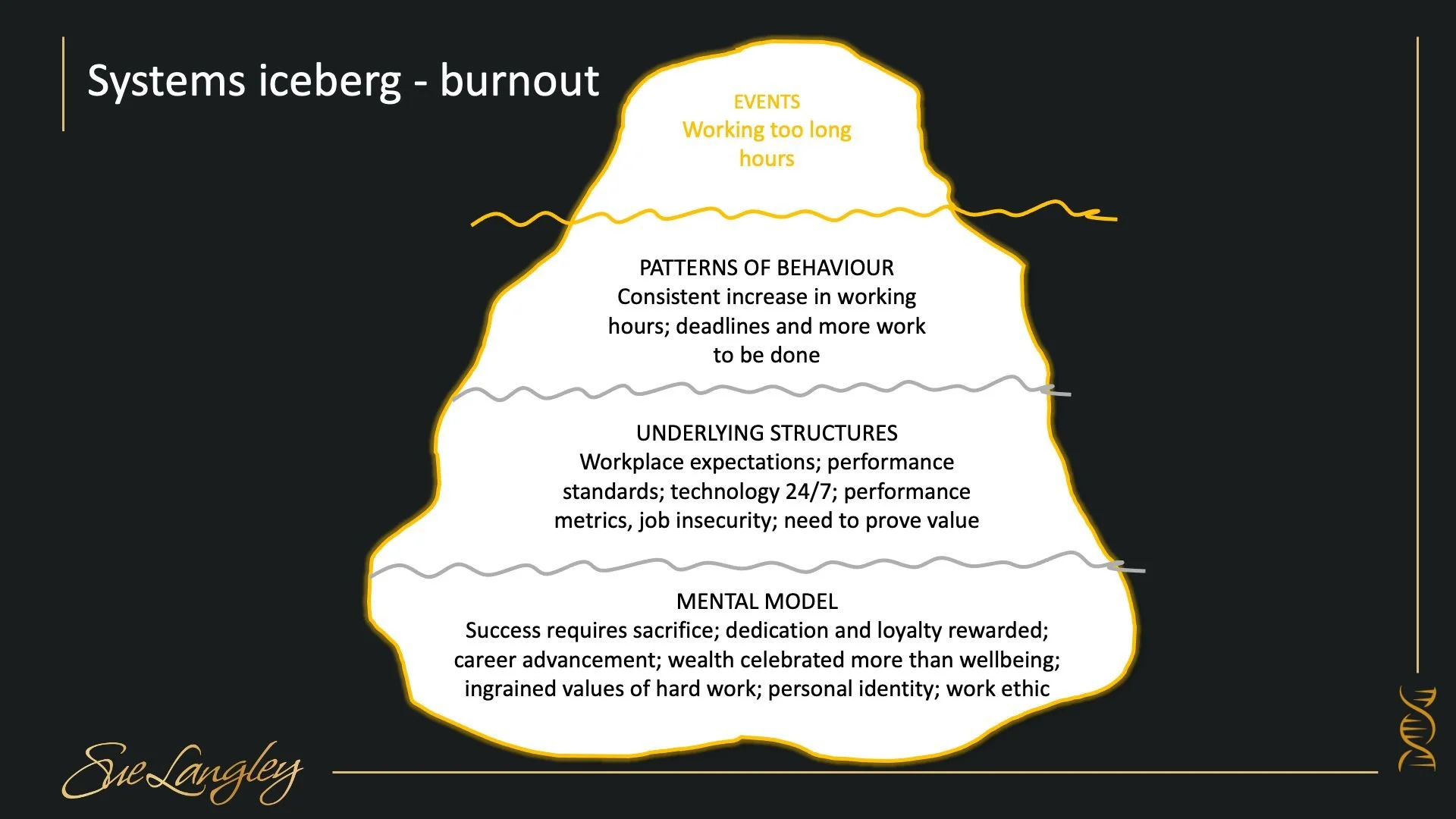
Sue has a gift for making complex ideas practical. In this conversation, she introduces her Systems Burnout Iceberg framework, helping us see that what we notice on the surface, such as long hours, constant busyness and depleted energy, is often only the visible tip of something deeper.
Beneath that surface sit patterns of behaviour that have gradually become normal. Underneath those patterns are organisational structures shaping what feels possible. And at the very base are the mental models we hold about dedication, loyalty, success and what it means to be good at our job.
Why does this conversation matter?
School life has become increasingly complex. The pace has accelerated, expectations have expanded, and the emotional demands placed on educators continue to grow. Many school staff are carrying significant professional and relational responsibilities, often without clear boundaries around where the work begins and ends. When burnout becomes widespread, it invites us to consider a broader perspective.
Rather than asking only what needs to change within the individual, it is worth examining what is shaping the way we are working. Individual wellbeing matters deeply. Our habits, boundaries and deliberate actions are important. However, we do not work in isolation. Our behaviours are influenced by patterns that have become normal, shaped by organisational structures, and underpinned by shared beliefs about dedication, success and service. When we understand these influences more clearly, self blame gives way to perspective. What feels like personal weakness may, in fact, be a very human response to the conditions we are working in.
You can quote us on that…
“Burnout is a sense of feeling overwhelmed by stuff. There is more coming at us than we have the ability currently to handle.”
- Sue Langley
“Mental models can be what you think it means to be a good person.”
- Sue Langley
Contact
Sue Langley Website| LinkedIn| YouTube
Want to learn more?
The learning doesn’t have to stop here. Get your free dose of wellbeing education in your inbox with Meg’s Thought Of The Week. Click here to subscribe.
Loved this episode?
The best way you can support The School of Wellbeing podcast is by sharing this episode with your family, friends and other big-hearted humans in your life! Click here to subscribe and share.
Like what you hear?
Please leave me a review – I love a gold star as much as the next teacher! Click here to review The School of Wellbeing Podcast.
Your Questions Answered:
What causes teacher burnout in schools today?
Teacher burnout is rarely caused by a single factor. It is the result of sustained workload, emotional intensity, increasing complexity, and the normalisation of dysfunctional ways of working. Many educators are navigating high expectations, limited time, and competing priorities, all while caring deeply about their students. Burnout is not a sign of weakness. It is often a very human response to demanding conditions. When we look at both individual habits and the wider systems shaping school life, we begin to see the full picture.
How can school leaders reduce staff burnout?
Reducing staff burnout requires more than encouraging resilience. Leaders can make a meaningful difference by examining workload expectations, clarifying priorities, modelling healthy boundaries, and challenging norms that reward overworking. Sustainable wellbeing comes from aligning structures, policies and culture with what is realistic and human. When leaders address both the system and the individual, staff feel supported rather than stretched.
Why does teacher burnout feel like it suddenly hits all at once?
Burnout rarely arrives overnight. It builds slowly through repeated behaviours such as staying late, skipping breaks or always being available. Over time, these patterns become normal. They are reinforced by school structures and beliefs about what it means to be dedicated. Eventually, the accumulated strain impacts our energy and nervous system, and it can feel sudden. But usually, it has been building quietly beneath the surface.
How can educators manage burnout beyond basic self-care strategies?
Managing burnout requires looking beyond surface level stress management. Self-care matters, but it is not enough on its own. Educators benefit from identifying repeated patterns, questioning unspoken expectations, and reflecting on beliefs such as success requires sacrifice. Small, deliberate shifts in both habits and context can create meaningful change. The goal is not to add more pressure, but to work more sustainably.
What is systems thinking in education and why does it matter for wellbeing?
Systems thinking in education means recognising that our behaviours sit within broader patterns, structures and shared beliefs. Instead of asking only what is wrong with the individual, we ask what is shaping the conditions. This perspective helps schools move from reactive wellbeing initiatives to more thoughtful, sustainable approaches. It creates clarity instead of blame.
What is the best podcast for teachers dealing with burnout and wellbeing?
The School of Wellbeing, hosted by Meg Durham, supports educators navigating burnout, stress and the increasing intensity of school life. It blends practical strategies with systems awareness, helping teachers and leaders understand both personal habits and the wider conditions shaping their work. Conversations, like this episode with Sue Langley, offer grounded insights and realistic steps toward sustainable wellbeing.
